Basis

Return to the Main Page

Wave

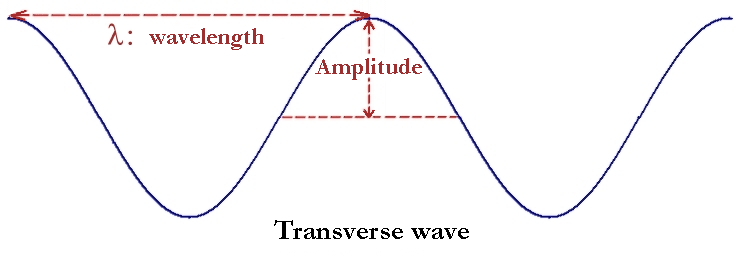
A wave is a disturbance that propagates through space. When the disturbance is perpendicular to the direction of propagation, the wave is called transverse. Electromagnetic waves used in our virtual experiment are transverse since both the electric and the magnetic fields are perpendicular between them and to the direction of propagation. Every  wave function depends on two variables, time and position, and so it has to be represented not in static way but in an animated way. However, we can assume a given instant in time and represent the disturbance as a function of the position. For an harmonic wave we have (being the horizontal axis the position:

Transverse wave
 

Interference

A fundamental characteristic of waves is the fact that when two waves meet in space their individual disturbances superimpose and add algebraically (we call it interference). For harmonic waves, the output situation lies between the two following cases:
 
- constructive:
combination of harmonic waves coming from two sources of the same frequency and wavelength with a difference of phase of 0 or multiple of 2p. The amplitude that one will get is equal to the sum of the individual amplitudes, and the value of the intensity  will be a maximum.
 
- destructive:
combination of harmonic waves coming from two sources of the same frequency and wavelength with a difference of phase equal to p or multiple of p. The amplitude that one will get is equal to the difference of the individual amplitudes, and so the value of the intensity  will be a minimum.
 
In the case of light, the interference produces a sequence of bands alternatively bright and dark that  correspond to constructive and destructive interferences.
Scheme of the interference

Coherent sources:

In order to observe a permanent pattern of interference one needs to have coherent sources. Two sources that are in phase or have a constant phase difference are said to be coherent.

Remark about the algorithm of simulation

 
The basis of the our simulation algorithm  is considering the slits as punctual sources emitting spherical waves. One takes the expression of the electric field of each slit, performs the superposition at a given  point of the screen, where the interference pattern is collected, and finally one computes a  magnitude that is proportional to the intensity of the light, making the mean of the square of the total field at this point. In the graphical output  we always plot the normalized intensity (using the maximum value of the intensity, which it's the value that we find in the central point of the screen).

We have to remark that in all simulations we perform an   "ab initio" calculation, starting only from the electric fields and letting that the numeric program does the corresponding superposition. It never uses the final formulae that you can find in the literature for some cases.


Return to the Main Page